|
|
|
The need for an instrument like HMI was recognized in 1996 with the conceptual design developed in 1998. The SDO mission definition study in 2001 clarified the requirements, with real work on HMI beginning after a competitive selection process in 2002. The Helioseismic and Magnetic Imager is a new and improved version of the Michelson Doppler Imager (MDI) instrument on the Solar and Heliospheric Observatory ( 1988 by the same
collaboration between Stanford and Lockheed teams that developed HMI. launched in December 1995. SOHO/MDI is presently still operating well and has completed helioseismic and magnetic field observation of the Sun for all of solar cycle 23 and the beginning of cycle 24. HMI will continue these important measurements from space into the next solar cycle. We hope and anticipate that SDO/HMI will enable deeper understanding of solar processes during most of solar cycle 24. |
|
Helioseismic & Magnetic Imager Solar Dynamics Observatory |
|
The HMI Team: High Altitude Observatory, and 22 Co-Investigator Institutions |
|
HMI Major Science Goals |
|
The primary goal of the Helioseismic and Magnetic Imager (HMI) investigation is to study the origin of solar variability and to characterize and understand the Sun’s interior and the various components of magnetic activity. The HMI investigation is based on measurements obtained with the HMI instrument, one of the three instruments that make up the Solar Dynamics Observatory (SDO) mission. HMI makes measurements of the motion of the solar photosphere to study solar oscillations and measurements of the polarization in a specific spectral line to study all three components of the photospheric magnetic field. |
|
HMI produces data to determine the interior sources and mechanisms of solar variability and how the physical processes inside the Sun are related to surface magnetic field and activity. It also produces data to enable estimates of the coronal magnetic field for studies of variability in the extended solar atmosphere which is where the Earth is. Solar variability that effects the Earth is called “space weather.” |
|
HMI observations will help establish the relationships between internal dynamics and magnetic activity. In turn this will lead to better understanding of solar variability and its effects. This will lead to reliable predictive capability, one of the key elements of the Living With a Star (LWS) program. |
|
HMI investigation goals are to observe and understand these interlinked processes of magnetic activity and internal dynamics including: |
|
SDO web link: http://sdo.gsfc.nasa.gov HMI web link: http://hmi.stanford.edu HMI/AIA JSOC data center web link: http://jsoc.stanford.edu |
|
HMI Team |
|
HEPL, **Phil Scherrer *Richard Bogart *Rock Bush *Tom Duvall, Jr. *J.Todd Hoeksema *Alexander Kosovichev *Jesper Schou *XuePu Zhao Jim Aloise Art Amezcua Taeil Bai John Beck Kelly Beck Elena Benevolenskaya Sudeepto Chakraborty Keh-Cheng Millie Chethik Nancy Christensen Carl Cimilluca Sebastien Couvidat Priya Desai Romeo Durscher Christina Green Thomas Hartlep Keiji Hayashi Tim Huynh Stathis Ilonidis Kevin Kempter Irina Kitiashvili Pavel Kosovichev Anna Kosovicheva Rasmus Larsen Tim Larson Yang Liu Leyan Lo James Mason Rakesh Nigam Konstantin Parchevsky Bala Poduval M, Christina Rabello- Soares Brian Roberts Kim Ross |
|
Deborah Scherrer Jeneen Sommers Jennifer Spencer Margie Stehle Xudong Sun Hao Thai Karen Tian Richard Wachter Jeff Wade Junwei Zhao HEPL Staff |
|
LMSAL *Alan Title *Karel Schrijver *TedTarbell Dave Akin Brett Allard Ron Baraze M. Baziuk Tom Berger Paul Boerner E. Bogle Bob Caravalho Brock Carpenter C. Cheung Roger Chevalier K. Chulick Tom Cruz Jerry Drake Dexter Duncan Jay Dusenbury Chris Edwards Janet Embrich Cliff Evans Peter Feher Barbara Fischer Chuck Fischer Sam Freeland Frank Friedlander Glen Gradwohl Hank Hacook Gary Heyman Bob Honeycutt Elizabeth Hui Bruce Imai Jerry Janecka Romona Jimenez Dwana Kacensky Pete Kacensky |
|
Claude Kam Karen Kao Noah Katz Dave Kirkpatrick Gary Kushner Michael Levay Russ Lindgren Gary Linford Andrea Lynch Dnyanesh Mathur Ed McFeaters John Miles Keith Mitchell Sarah Mitchell Ruth Mix Margaret Morgan Rose Navarro Tom Nichols Tracey Niles Jackie Pokorny Rick Rairden Roger Rehse J.-P. Riley David Schiff Isella Scott Cherl Seeley Ralph Sequin Dick Shine Araya Silpikul Larry Springer Bob Stern Louie Tavarez R. Timmons Edgar Thomas Darrell Torgerson Shan Varaitch Angel Vargas Dale Wolf Jake Wolfson Ross Yamamoto Carl Yanari Kent Zickuhr |
|
HAO *Steve Tomczyk Juan Borrero Gregory L. Card |
|
Anthony Darnell Rebecca C. Elliott David Elmore Jonathan Graham Aimee Norton Bruce Lites Arturo Lopez Ariste Matthias Rempel Hector Socas- Navarro |
|
JPL Michael Turman |
|
*Juri Toomre Benjamin Brown Gwen Dickenson Nicholas Fetherstone Deborah Haber Bradley Hindman Swati Routh Regner Trampedach |
|
NASA *Nagi Mansour *Alan Wray |
|
NJIT, BBSO *Phil Goode Vasyl Yurchyshyn |
|
NWRA/CoRA *Doug Braun *Tom Metcalf† *Charlie Lindsey Graham Barnes Aaron Birch Ashley Crouch K. D. Leka Orion Poplawski Martin Woodard |
|
NSO *Frank Hill *Rachel Howe Walter Allen Olga Burtseva Irene Gonzalez- Hernandez Kiran Jain Shukur Kholikov Rudi Komm |
|
Igor Suarez-Sola Sushanta Tripathy |
|
Predictive Science Inc. *Jon Linker Michael Choy Zoran Mickic Pete Riley Timofey Titov Janvier Wijaya |
|
SAO *Sylvain Korzennik Alisdair Davey |
|
UCLA *Roger Ulrich |
|
*Jeff Kuhn Marcelo Emilio Isabelle Scholl |
|
UMCP *Judit Pap |
|
USC *Ed J. Rhodes, Jr. Shawn Irish Johann Reiter Anthony Spinella |
|
*Sarbani Basu Charles Baldner |
|
International |
|
DK *Joergen Christensen- Dalsgaard |
|
*Douglas Gough |
|
ESA *Bernhard Fleck |
|
IIAP, IN Dipankar Banerjee Siraj Hasan S. Paul Rajaguru |
|
*Sami Solanki Raymond Burston Laurent Gizon Shravan Hanasoge Yacine Saidi |
|
*Len Culhane Elizabeth Auden |
|
NAOJ, JP *Takashi Sekii Kaori Nagashima |
|
*Richard Harrison |
|
*Mike Thompson |
|
Univ. *Hiromoto Shibahashi |
|
Industrial |
|
e2v - CCDs Gary Auker Rob Wilson |
|
RAL - Cameras Nick Waltham |
|
Light Machinery - Michelson interferometers John Hunter Ian Miller |
|
Corporation & Zygo Corporation - Filters John Cotton |
|
H. Magnetics - motors Ralph Horber |
|
• Convection-zone dynamics and the solar dynamo; • Origin and evolution of sunspots, active regions and complexes of activity; • Sources and drivers of solar activity and disturbances; • Links between the internal processes and dynamics of the corona & heliosphere; • Precursors of solar disturbances for space- weather forecasts. |
|
HMI Implementation |
|
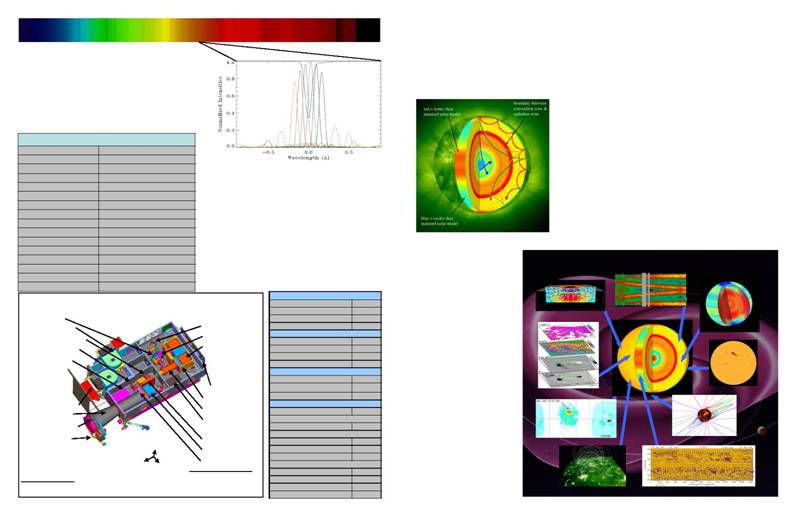
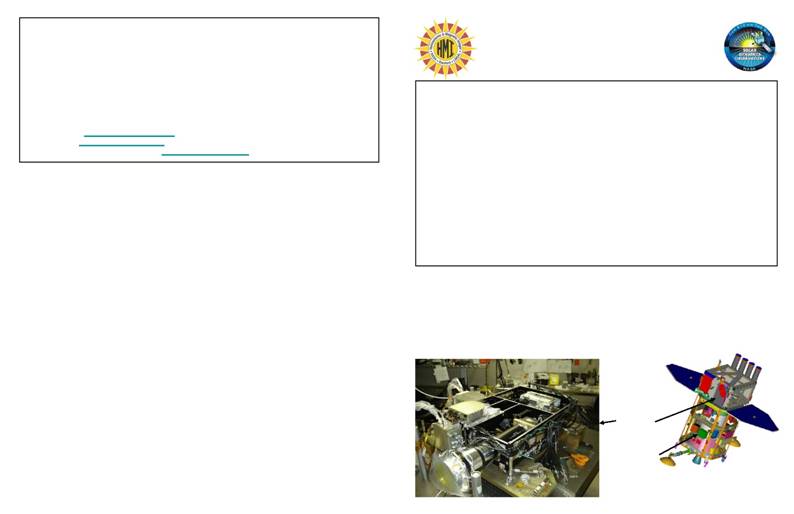
The HMI instrument design and observing strategy are based on the highly successful MDI instrument, with several important improvements. HMI will observe the full solar disk in the Fe I absorption line at 6173Å with a resolution of 1 arc-second. HMI consists of a refracting telescope, a polarization selector, an image stabilization system, a narrow band tunable filter and two 4096² pixel CCD cameras with mechanical shutters and control electronics. The continuous data rate is 55Mbits/s. |
|
Images are made in a sequence of tuning and polarizations at a 4-second cadence for each camera. One camera is dedicated to a 45s Doppler and line-of-sight field sequence while the other to a 90s vector field sequence. All of the images are downlinked for processing at the HMI/AIA Joint
Science Operations Center at |
|
SDO |
|
and |
|
HMI |
|
HMI Optics Package |
|
*Co-Investigator, **Principal Investigator, HEPL: W.W. Hansen Experimental Physics Laboratory; LMSAL: Lockheed-Martin Solar and Astrophysics Laboratory; HAO: High Altitude Observatory; JPL: Jet Propulsion Laboratory; NJIT,BBSO: New Jersey Institute of Technology, Big Bear Solar Observatory; CoRA: Space Science
Laboratory; NAOJ: National Astrophysical
Observatory of |
|
HMI Electronics Box |
|
The Solar Dynamics Observatory will be placed into an inclined geosynchronous orbit to maximize sunlit hours while providing high bandwidth telemetry. Launch is scheduled for February 2010. |