Tag Archives: helioseismology

223. Helioseismic evidence that the solar dynamo originates near the tachocline

Contributed by Krishnendu Mandal. Posted on February 26, 2026

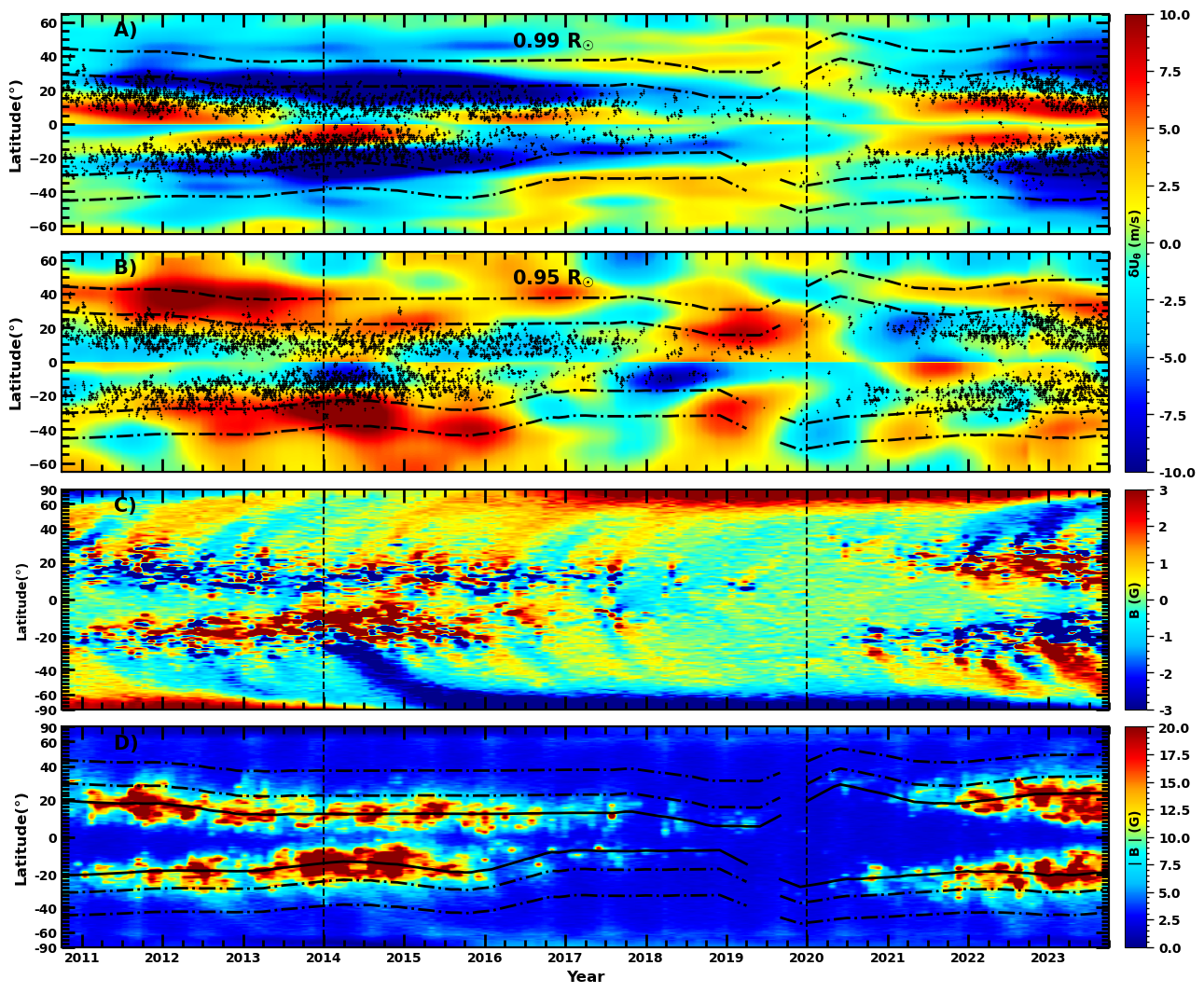
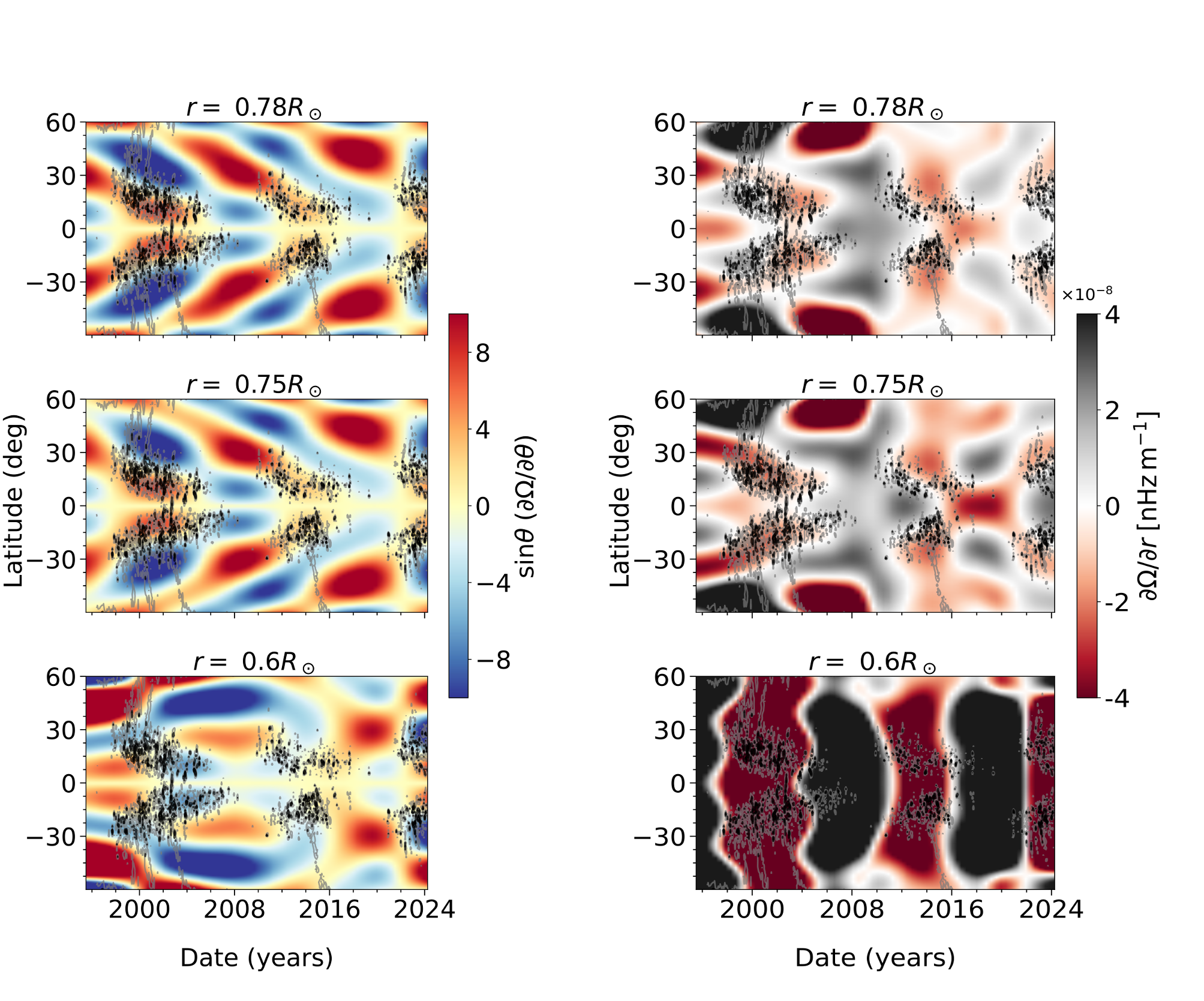
Helioseismic analysis of solar torsional oscillations reveals dynamo-wave–like signatures that originate near the tachocline and propagate through the convection zone, linking internal zonal flows to the surface magnetic cycle. Additional evidence from frequency-splitting coefficients and rotational shear variations shows strong solar-cycle correlations, supporting the tachocline as a primary site of solar dynamo action.

220. Stray Light Correction applied to HMI Data

Contributed by A.A. Norton. Posted on February 7, 2026

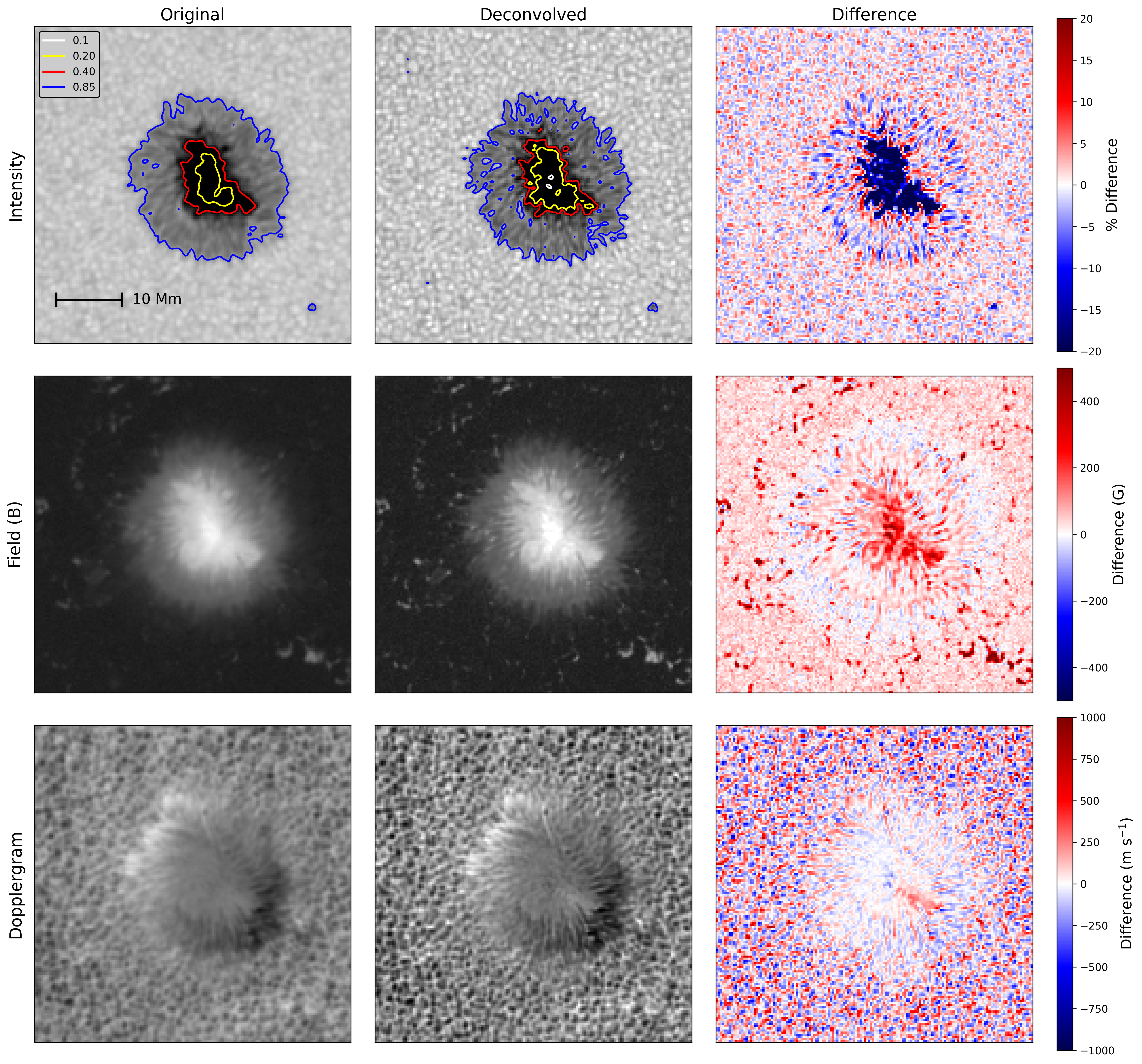
We report a point spread function (PSF) and deconvolution procedure to remove stray light from the Helioseismic and Magnetic Imager (HMI) data. The deconvolution uses a Richardson-Lucy algorithm and takes less than one second per full-disk image. In 2018, the HMI team began providing full-disk, stray-light-corrected data daily. The results, on average, show decreases in umbral continuum intensity, a doubling of the granulation intensity contrast, increases in the total field strength, most notably in plage by ∼1.4–2.5 the original value, and a partial correction for the convective blueshift.

213. Seismology of Parker-Fragmentation of Magnetic Flux beneath Sunspot Photospheres

Contributed by Charlie Lindsey & Alina Donea. Posted on June 16, 2025

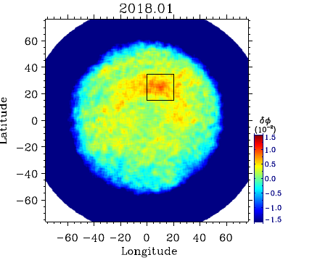
Strong acoustic scatterers are found beneath sunspot umbrae and penumbrae using the phase-correlation holography method. These scatterers indicate the fragmentation of magnetic flux, as suggested by Eugene Parker in the 1970s.

196. Observations of Rossby wave parameter variations during solar cycle 24

Contributed by Mattias Waidele. Posted on September 25, 2023

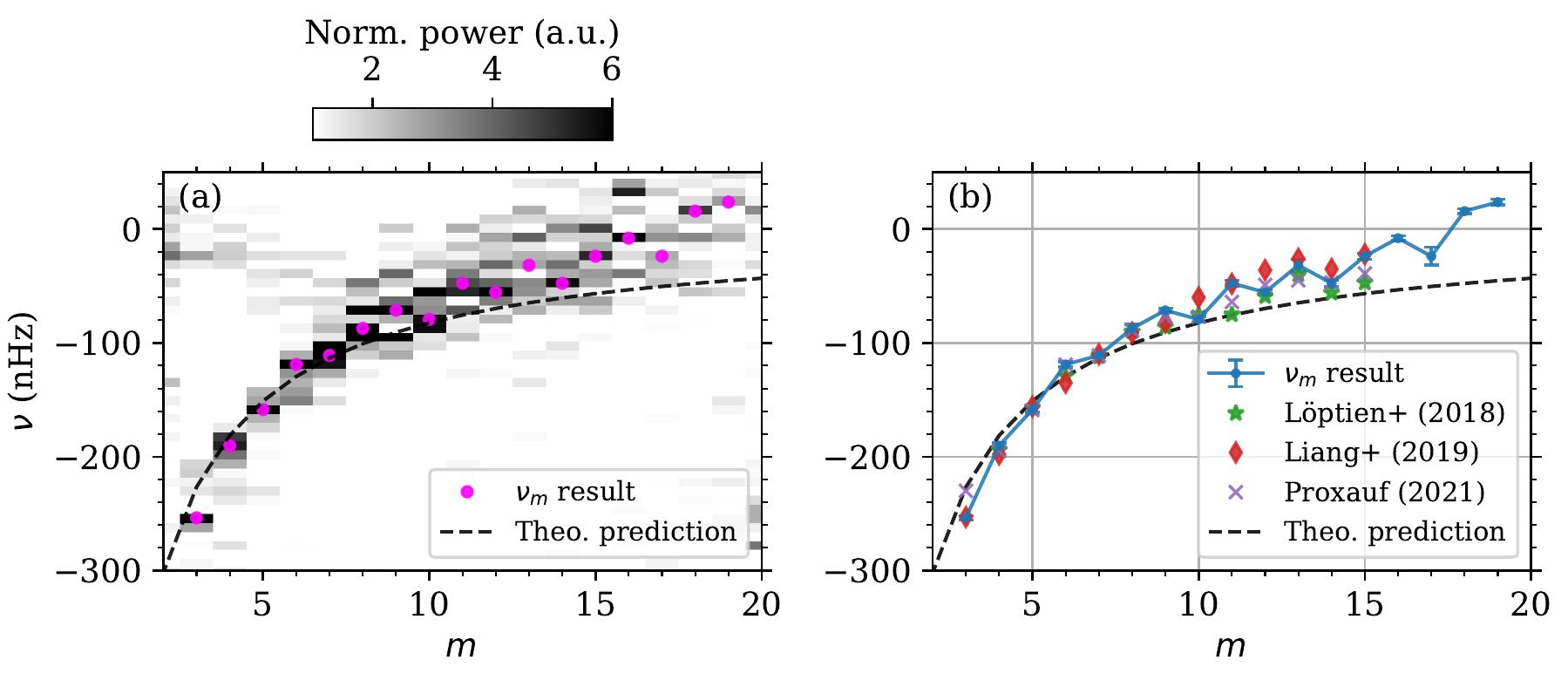
Equatorial Rossby waves are detected using the HMI’s time-distance subsurface flow fields. It is also found that the power of the Rossby waves show a positive correlation with the sunspot number, while the frequency of the waves shows an anti-correlation with the sunspot number.

189. Spatial Scales and Time Variation of Solar Subsurface Convection

Contributed by Alexander Getling. Posted on October 31, 2022

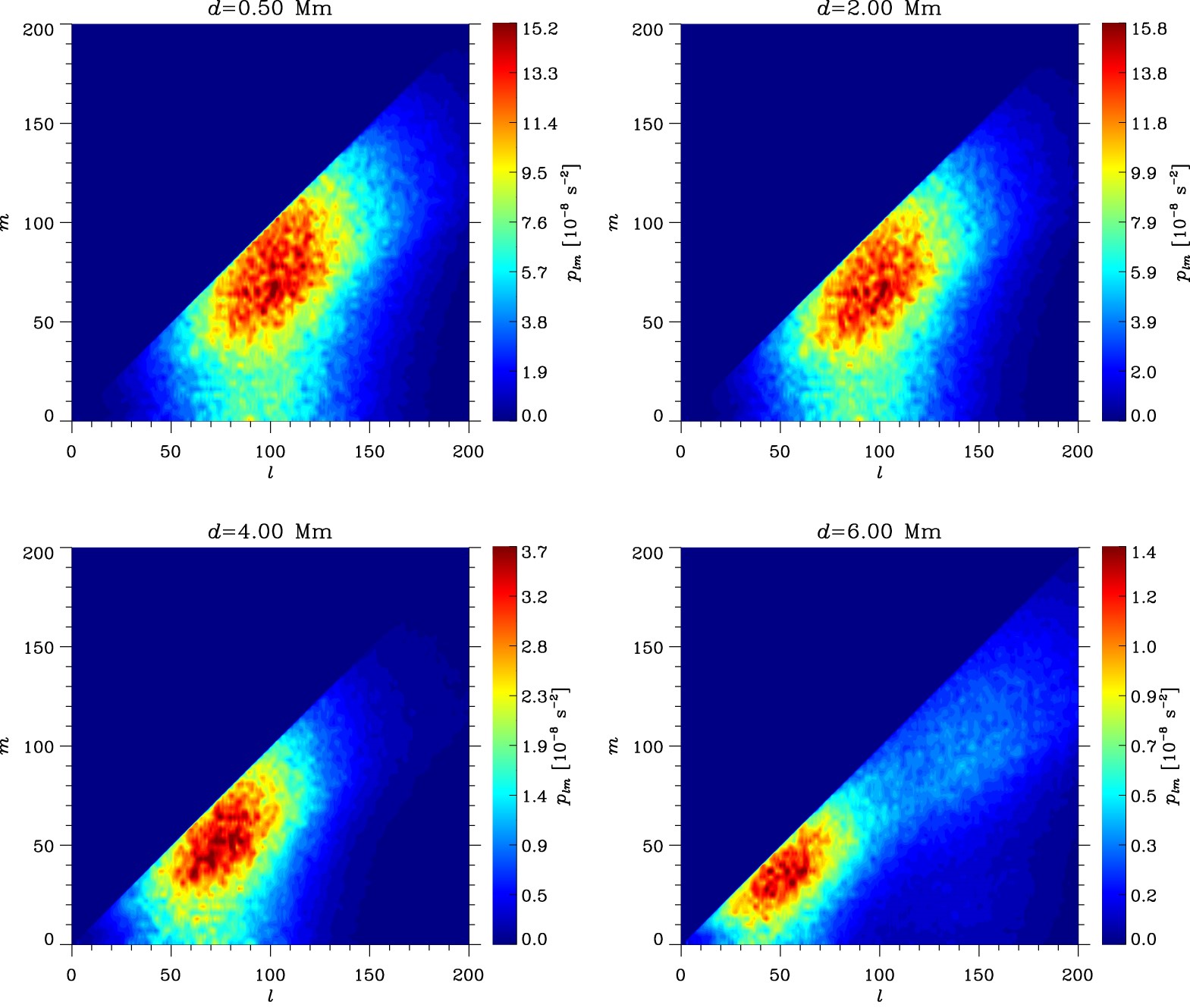
Spectral analysis of the spatial structure of solar subphotospheric convection is carried out for subsurface flow maps. It is found that the horizontal flow scales increase rapidly with depth, from supergranulation to giant-cell values. The total power of the convective flows is found to be anticorrelated with the sunspot number variation over the solar activity cycle in shallow subsurface layers and positively correlated at larger depths.

188. Constraining Global Solar Models through Helioseismic Analysis

Contributed by Andrey Stejko. Posted on October 28, 2022

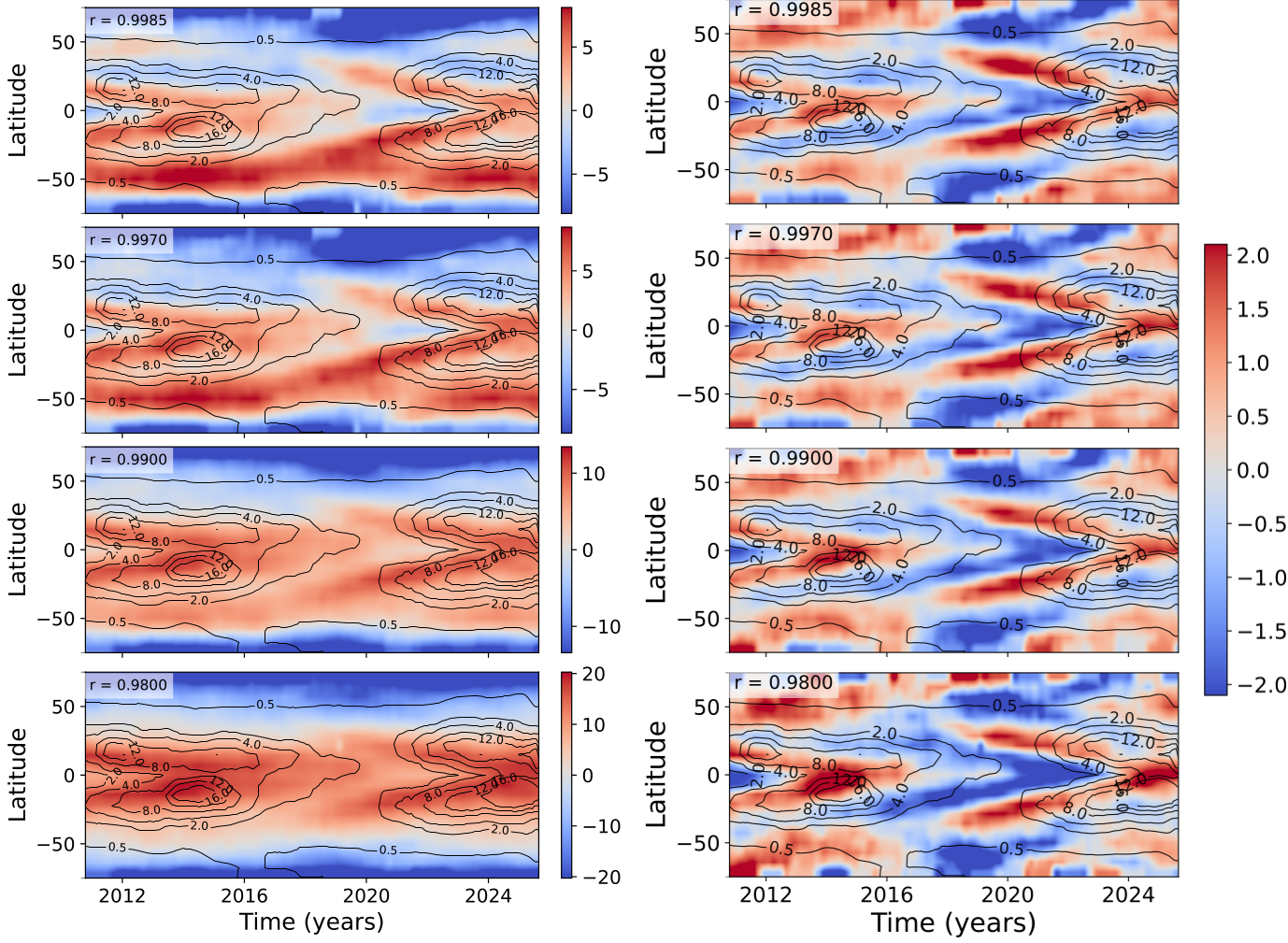
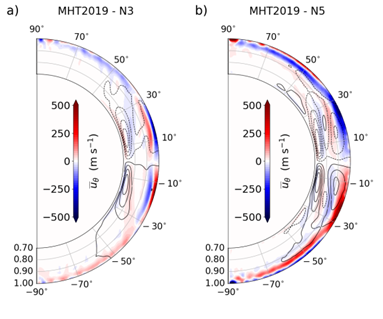
Forward modeling is applied to numerous global hydrodynamic solar models, and helioseismic measurements on the meridional circulation are made using the forward modeling results. Comparison against the observational measurements shows significant differences, indicating our insufficient knowledge on either the global hydrodynamic modeling or the helioseismic inversions.

183. Phase shifts measured in evanescent acoustic waves above the solar photosphere and their possible impacts on local helioseismology

Contributed by Junwei Zhao. Posted on July 31, 2022

Analysis on high-spectral resolution data shows that oscillations in the higher atmosphere lead those in the lower atmosphere by an order of 1 s when their frequencies are below about 3.0 mHz, and lags behind by about 1 s when their frequencies are above 3.0 mHz. These phase shifts in the evanescent waves pose great challenges to the interpretation of some local helioseismic measurements that involve data acquired at different atmospheric heights.