Tag Archives: magnetic field

225. Data-Driven Modeling Unveils the Magnetic “Sigmoid” Triggering a Major CME

Contributed by Sanjay Gosain. Posted on April 7, 2026

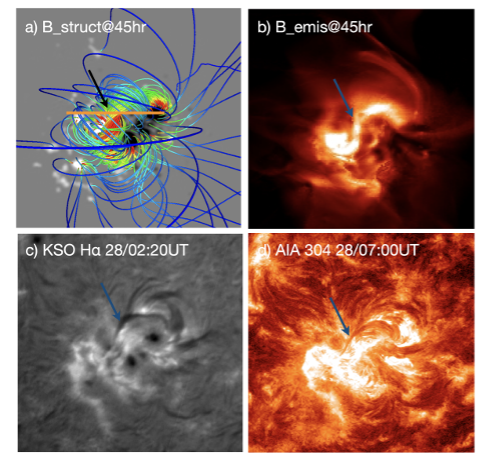
Magnetofrictional simulations of Active Region 13500 reproduce its transition from stability to eruption and show that a massive sigmoid flux rope formed during the decay phase. The eruption began when the current-carrying helicity ratio reached about 0.3, indicating that helicity-based markers can help diagnose the eruptive potential of active regions.

222. On the Need for Rescaling Regular Synoptic Maps of the Solar Radial Magnetic Field

Contributed by Yang Liu. Posted on February 26, 2026

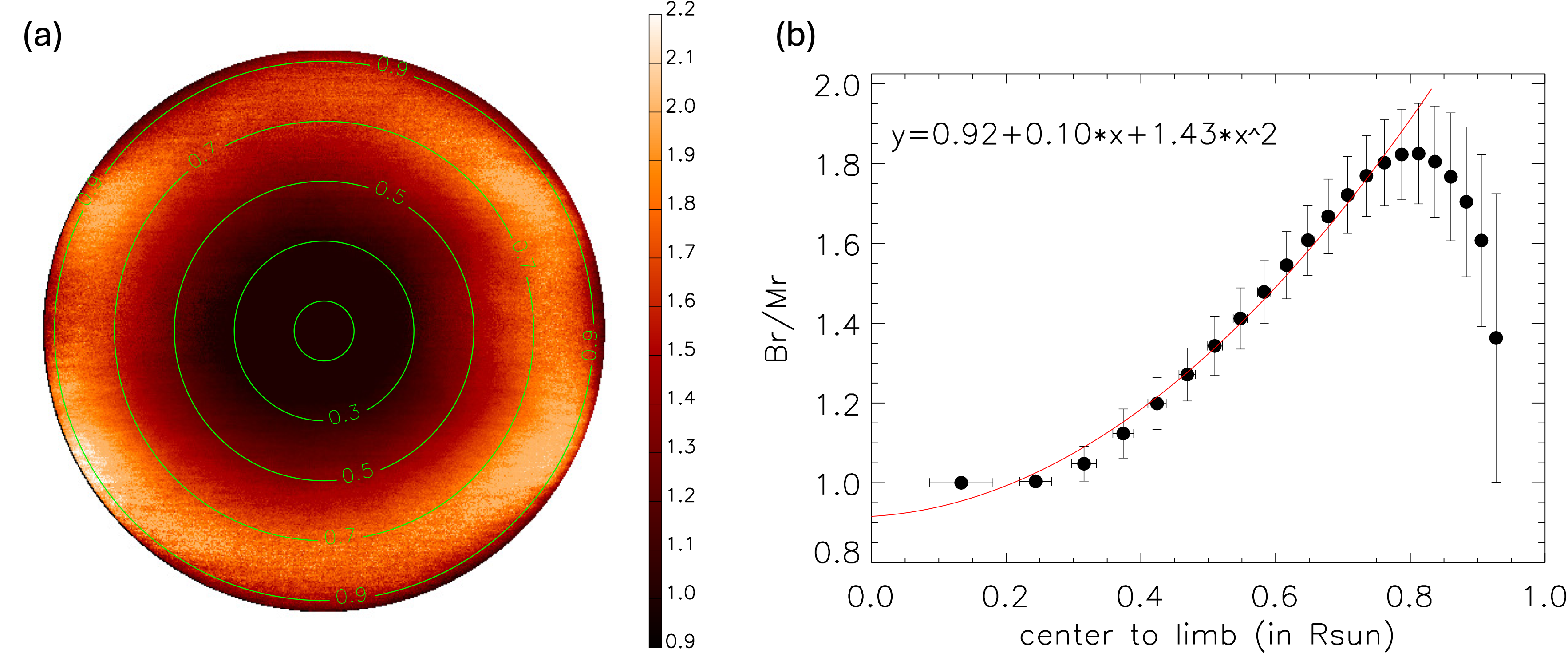
A statistical comparison between HMI vector magnetograms and line-of-sight–derived radial fields shows that LOS-based estimates systematically underestimate the true radial field, with the bias increasing toward the limb. A numerical modeling demonstrate that this center-to-limb variation in the underestimation of radial field arises from non-radial magnetic field inclinations.

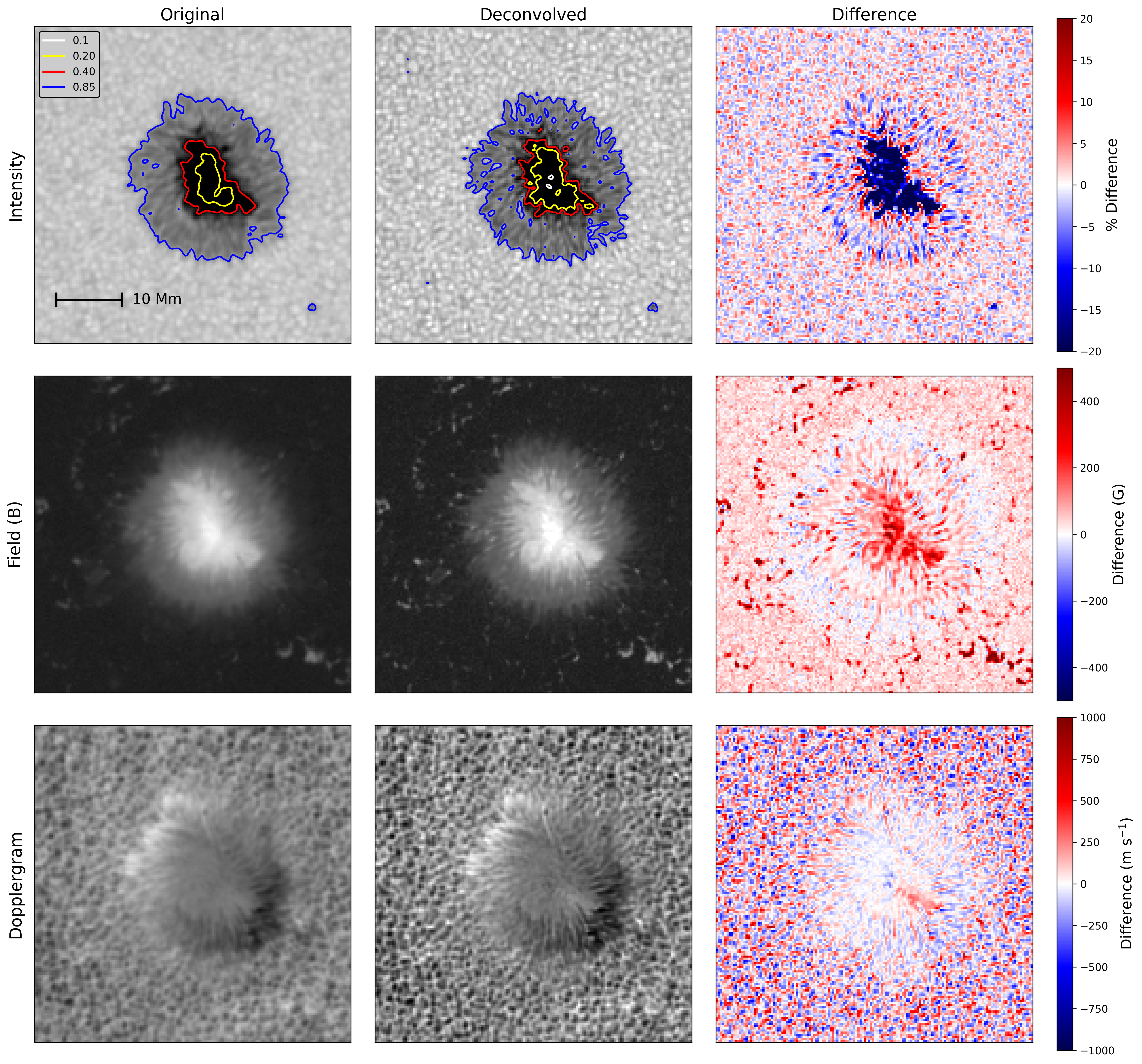
220. Stray Light Correction applied to HMI Data

Contributed by A.A. Norton. Posted on February 7, 2026

We report a point spread function (PSF) and deconvolution procedure to remove stray light from the Helioseismic and Magnetic Imager (HMI) data. The deconvolution uses a Richardson-Lucy algorithm and takes less than one second per full-disk image. In 2018, the HMI team began providing full-disk, stray-light-corrected data daily. The results, on average, show decreases in umbral continuum intensity, a doubling of the granulation intensity contrast, increases in the total field strength, most notably in plage by ∼1.4–2.5 the original value, and a partial correction for the convective blueshift.

219. SOHO/MDI and SDO/HMI Sunspot Area Measurement

Contributed by Peter Meadows. Posted on October 14, 2025

A robust, calibrated method for measuring sunspot areas from SOHO/MDI and SDO/HMI full-disk images enables a consistent, observer-independent, long-term catalogue of daily sunspot areas, revealing detailed patterns of sunspot group area evolution and solar cycle variability.

218. Reversal of Current Helicity Trend During Solar Eruptions

Contributed by Zheng Sun. Posted on October 13, 2025

Through MHD simulations of flux eruptions, the study finds that the current helicity decreases prior to eruptions and then reverses to increase afterward. By examining multiple flare events, the authors identified observational evidence supporting these simulation results.

217. Mother’s Day 2024 Superstorms: Tracing the Roots of Solar Eruptions Weeks Ahead

Contributed by Mausumi Dikpati. Posted on August 27, 2025

Multiple X-class flares and CMEs were produced by AR 13664/8 during the Mother’s Day week of 2024. This study suggests that predicting the locations of magnetically complex active regions, and studying and tracking their eruptive states using different proxy parameters can greatly improve the capability to forecast intense storms.

216. An “Average” Solar Active Region: Revealing Common Patterns in Magnetic and Flow Evolution

Contributed by Michal Švanda. Posted on August 17, 2025

Each solar active region (AR) has its unique shape, size, and lifetime. In this work, the authors developed a method to ‘average’ bipolar ARs by normalizing their size, orientation, and timing, thereby revealing the typical properties of an AR and its evolutionary pattern.

215. Quantifying Suppression of Solar Surface Magnetic Flux Advection with Increasing Field Strength

Contributed by V. Aparna. Posted on July 30, 2025

It is widely known that magnetic fields suppress convection, but this effect has not been quantitatively assessed. Using vector magnetograms from HMI observations, the authors measured the advection speeds of magnetic flux as a function of field strength and found that the speeds steadily decrease with increasing field strength.

212. Deconvolving SDO/HMI Intensity and Vector Magnetic Field Data to Achieve Hinode/SOT-SP Quality

Contributed by David Korda. Posted on May 19, 2025

A deep convolutional neural network is trained using Hinode data that has been degraded to match the resolution and sensitivity of HMI observations. Once trained, the network can enhance HMI intensity and vector magnetic field data to the resolution and quality of Hinode.

210. The Role of Electric Currents in the October 2014 X1.6 Solar Flare

Contributed by Partha Chowdhury. Posted on April 28, 2025

The analysis of magnetic fields and electrical currents indicates that a specific configuration – currents in opposite magnetic regions flowing in the same direction and peaking concurrently – might create favorable conditions for the magnetic reconnection process that powers solar flares.