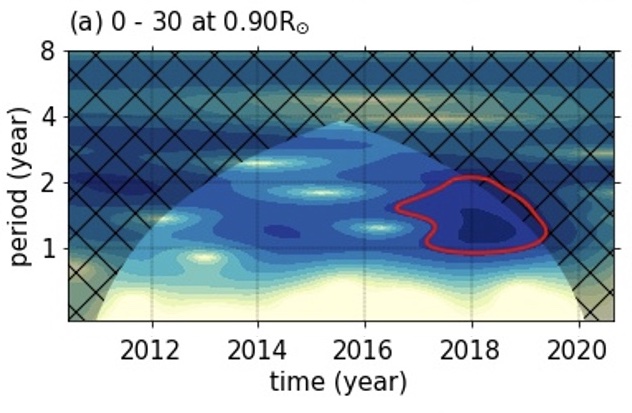
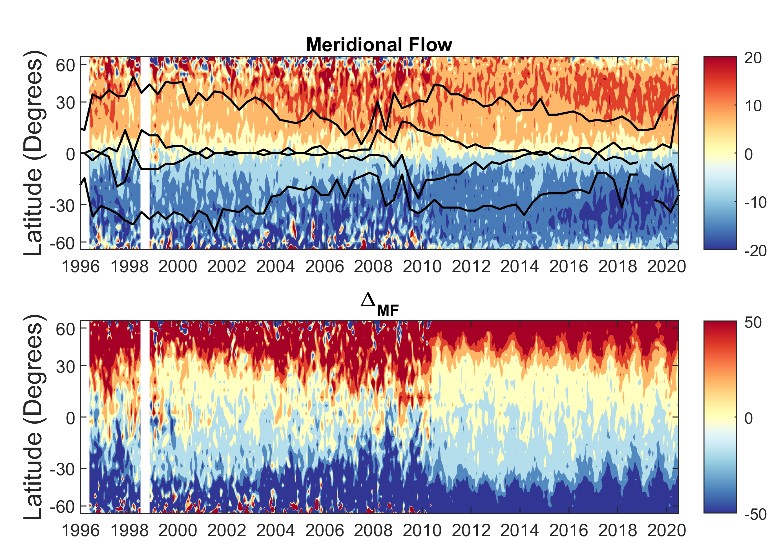
169. The QBO-type signals in the Subsurface flow fields during solar cycles 23 and 24
168. Introducing the SPEAR Catalogue from HMI Data
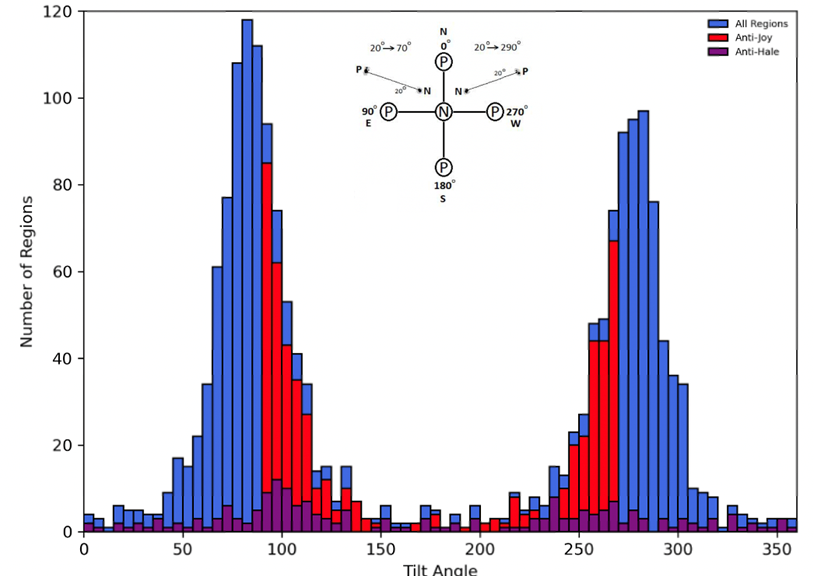
In order to make the properties of magnetic features observed by SDO/HMI more accessible, the Solar Photospheric Ephemeral and Active Region (SPEAR) catalogue has been created as an easy-to-read tabulated text file. Tilt angles from the SPEAR catalogue are shown as a histogram (top) and as a function of latitude (bottom) with colors indicating all regions (blue), regions with anti-Joy (red), and anti-Hale (purple) tilts. Over 40% of regions disobey the laws of Joy and Hale.
167. White-light Continuum Observation of the Off-limb Loops of the SOL2017-09-10 X8.2 Flare: Temporal and Spatial Variations
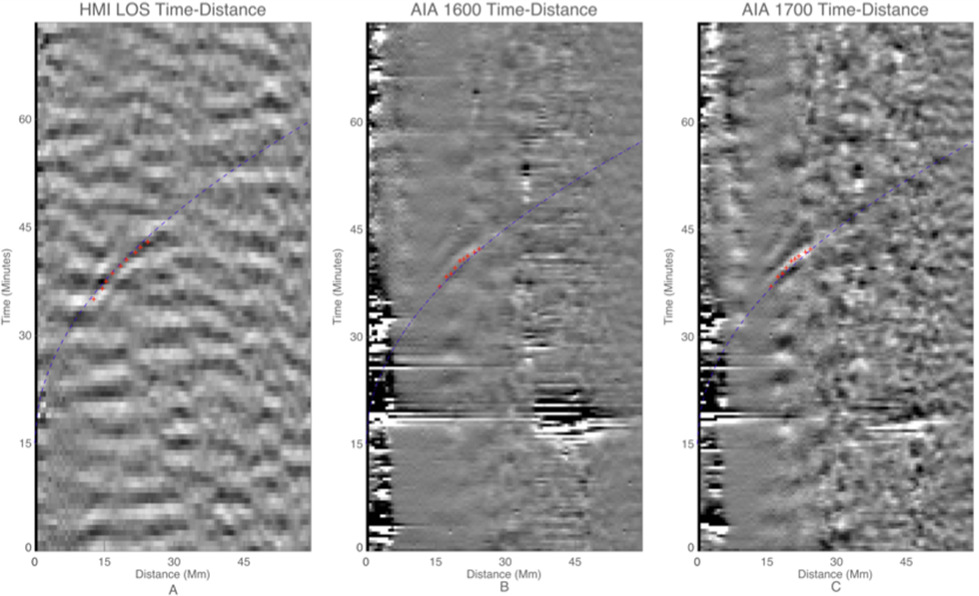
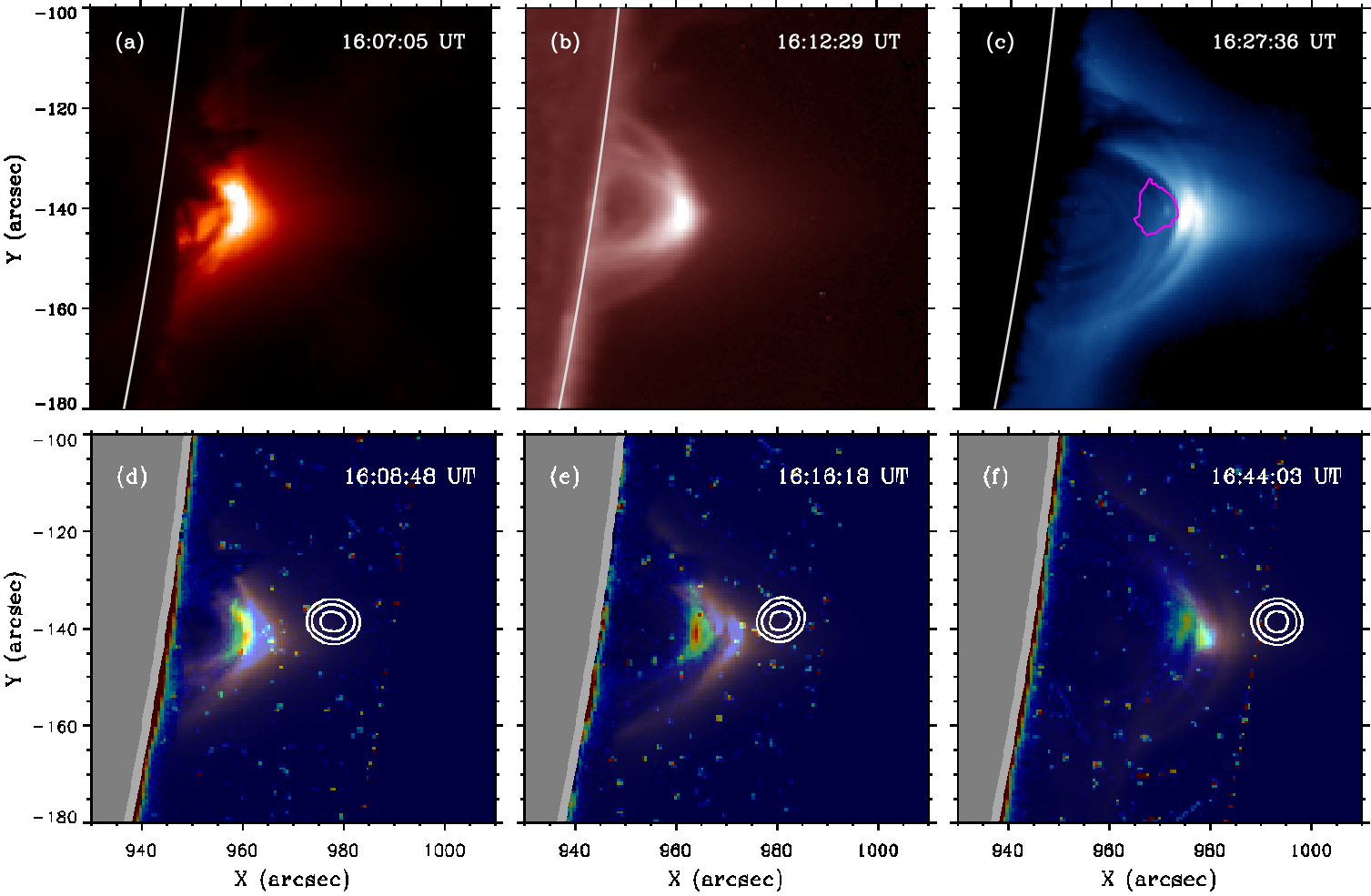
An unprecedented observation of a limb flare in HMI’s white-light continuum shows that the white-light intensity at the post-flare loop-top continues to grow for 16 more minutes while UV/EUV intensities decay. Both the WL/UV intensity and the EUV intensities show quasi-periodic pulsations with a period close to 8.0 and 6.8 minutes, respectively.
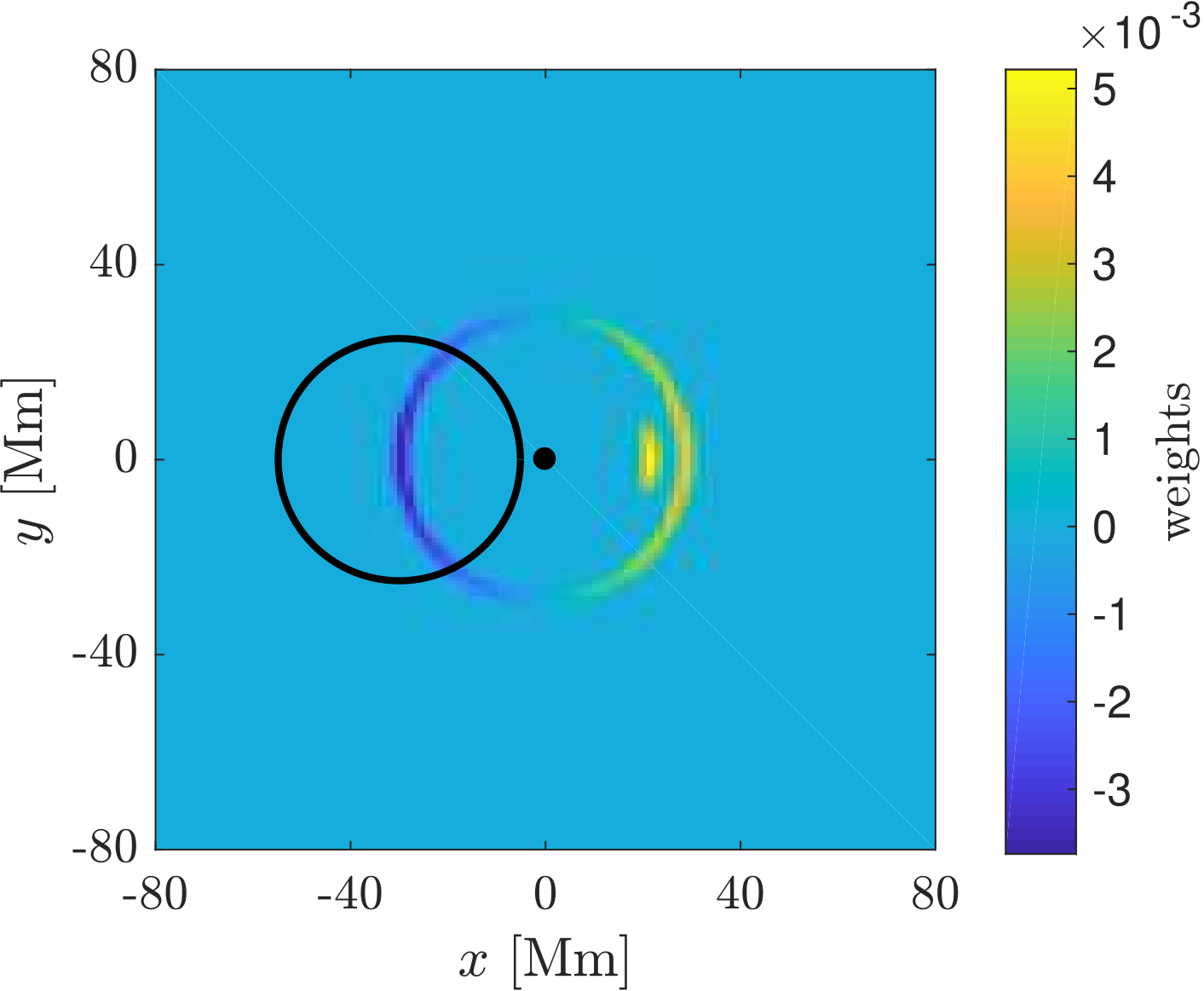
166. One-Sided Arc Averaging Geometries in Time-Distance Local Helioseismology
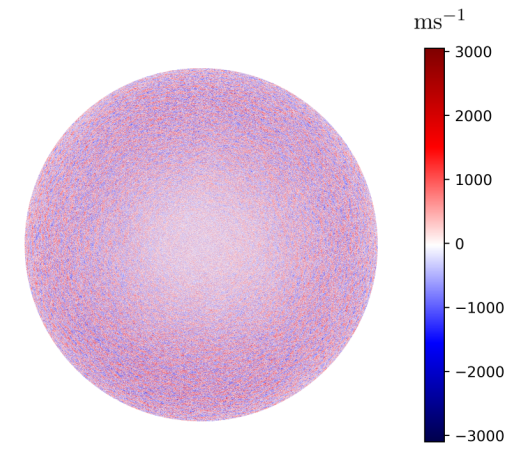
165. A Robust Methodology for the Correction of the Center-to-Limb Effect in Photospheric Velocity
164. Characterizing solar surface convection using Doppler measurements
163. A New Website Hosting HMI Time-Distance Pipeline Products
162. Increasing magnetic flux of active regions reduces CME eruptivity
161. Changes in granulation scales over the solar cycle seen with SDO/HMI and Hinode/SOT
An analysis of granule sizes over a few years of HMI observations shows that, even in quite regions, the granular size shows an anti-correlation with the solar magnetic activity with a time delay of about 300 days. The granular size decreases by about 2% during the activity maximum relative to the minimum.