Author Archives: admin

17. Is the recent discovery of the multi-cell meridional circulation a threat to the flux-transport dynamo?

Contributed by Bidya Binay Karak. Posted on May 27, 2014

Motivated by recent observations we have explored whether the flux-transport dynamo model can work with multi-cell meridional flow. We find that it can work when certain conditions are fulfilled.

16. Spatial-Variance Magnetic Synoptic Maps

Contributed by Luca Bertello. Posted on May 26, 2014

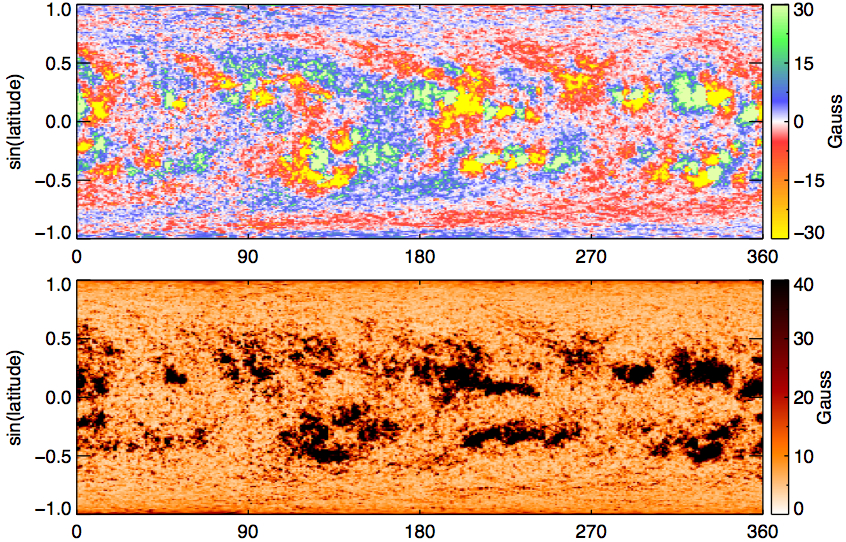
Bertello and collaborators at NSO have made a first attempt to estimate some of the uncertainties in magnetic synoptic maps and evaluated their impact on coronal and heliospheric models. They found that accounting for the statistical uncertainties arising from the distribution of image pixels contributing to each bin in the synoptic map may produce a noticeable change in the results obtained from these models.

15. Potential field source surface “breathes” over the course of the solar cycle

Contributed by WIlliam Arden. Posted on May 15, 2014

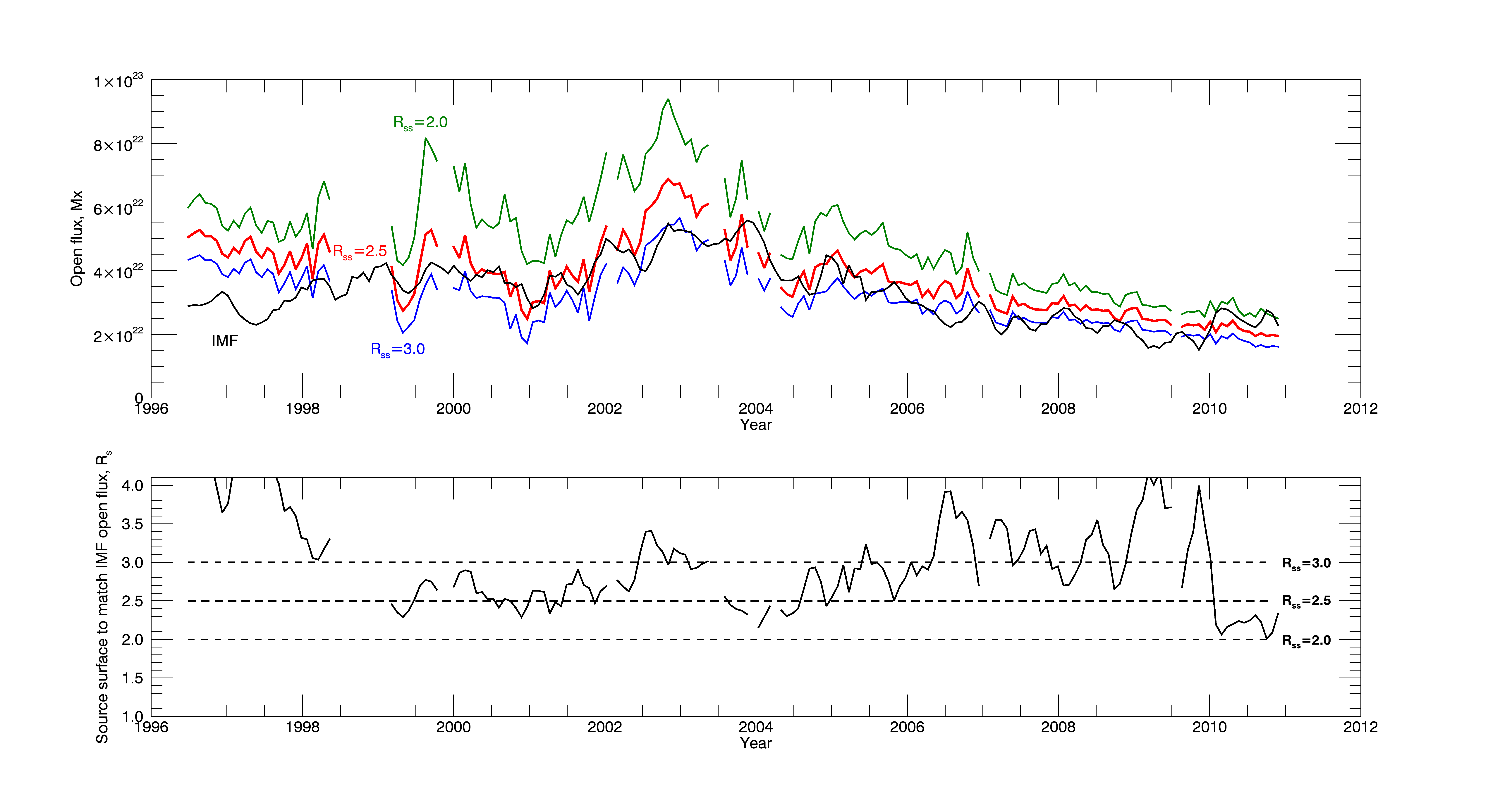
Our results show that raising the source surface height 15-30% during solar minimum (depending on the model used) better reproduces the observed IMF open flux from OMNI. We used two different PFSS models and the MDI/HMI magnetograms as input.

13. “G-nodes” Offer a New Way to Peek into the Sun’s Interior

Contributed by Scott McIntosh. Posted on April 30, 2014

We have seen that the quiescent photospheric magnetic field is composed of multiple connective scales. The observed scales range from a few megameters to those that are 100 –250 Mm in scale. We expect that the latter of these scales belongs to a spatially large, deep and hence slowly overturning convective flow — one that possibly reaches to the bottom of convection zone.

12. Analyzing 60,000 Supergranules to Determine their Subsurface Flow Profile

Contributed by Tom Duvall. Posted on April 29, 2014

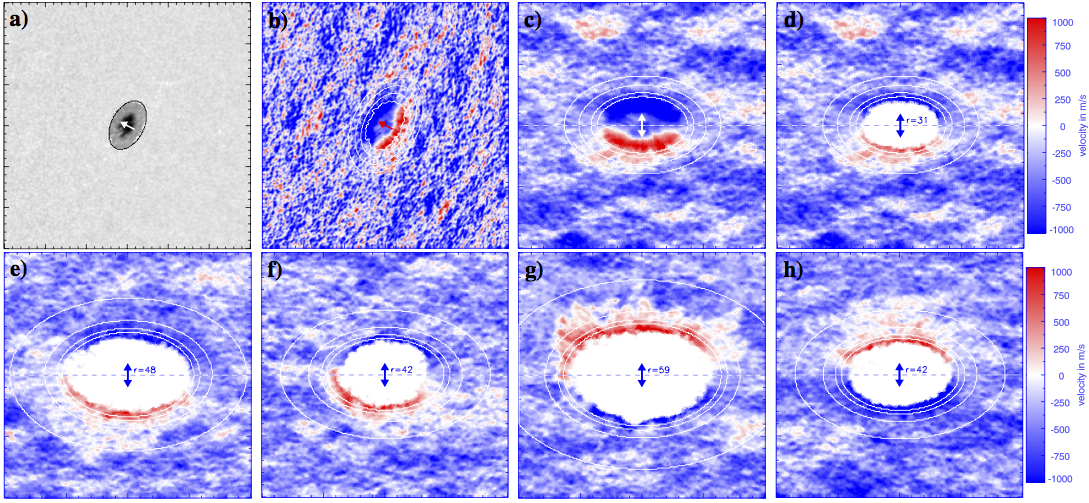
Analysis of a large number of supergranules observed with HMI and simulations with a convectively stabilized solar model imply that the average supergranular cell has a peak upflow of 240 m s-1 at a depth of 2.3 Mm and a corresponding peak outward horizontal flow of 700 m s-1 at a depth of 1.6 Mm.

11. The long-term trend in magnetic fields of sunspot umbrae

Contributed by Fraser Watson. Posted on April 25, 2014

I investigate the possible long term decrease in umbral magnetic field strengths from 1998-2006. Whereas a decrease of 800 Gauss in umbral magnetic fields has been reported between 1998 and 2012, the HMI and MDI data indicate a decrease of only around 300 Gauss. The continuing availability of the excellent HMI data set will allow us to continue to refine this study as solar cycle 24 evolves.